Saga Balloon Fiesta 2026: Where to Catch the Magic
123 colorful balloons, a river full of reflections, and a sunrise worth waking up for. Your guide to the 2026 Saga Balloon Fiesta: best photo spots, golden-hour timing, night illuminations, and how to get there.
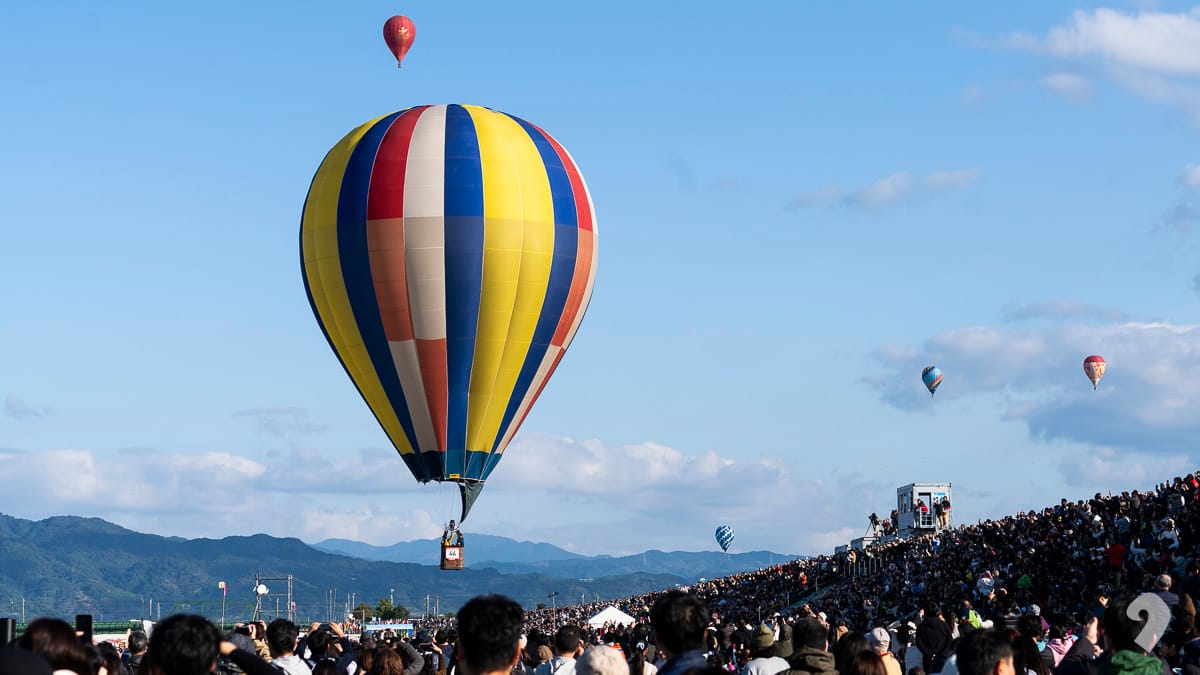
The 2026 Saga International Balloon Fiesta takes place from October 30 to November 3 on the Kase River floodplain in Saga City, and admission is free. More than 100 colorful hot-air balloons take to the skies after sunrise. The best photo window is 6:30–7:30 a.m., followed by the spectacular evening balloon illuminations on November 2 and 3.
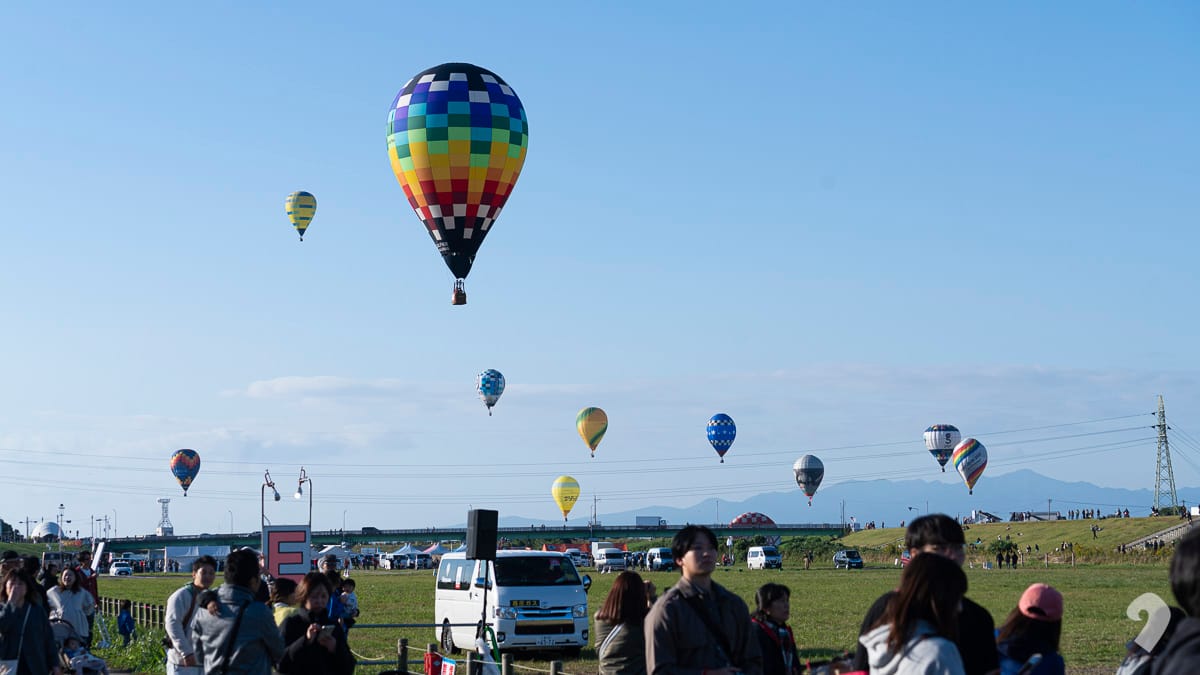
A sky filled with colorful hot-air balloons, their reflections shimmering in the still river below—you've probably seen that picture on social media. It was taken at the Saga International Balloon Fiesta (佐賀インターナショナルバルーンフェスタ), held every autumn. One of Asia's biggest balloon festivals, the 2026 event features 123 balloons; last year's five-day festival drew 838,000 visits. And yes, you can see that extraordinary sight for yourself right from the riverbank, with no ticket or reservation required. To capture your own version of the iconic shot, you just need to know three things: when the light is best, where to stand, and how to get close to the balloons.
When is the best time to take photos?
The morning session is your best bet. Aim to arrive before 6 a.m. Balloons start launching at 7 a.m., just over 20 minutes after sunrise, when the light is soft and the wind is usually at its calmest—giving flights the best chance of going ahead.
Here's how the morning and evening unfold, based on sunrise and sunset times from the National Astronomical Observatory of Japan and the festival's official schedule:
| Time | What's happening | What to photograph |
|---|---|---|
| Around 6 a.m. | Before sunrise, the sky shifts from deep blue to orange | Silhouettes heading toward the festival against the changing sky; balloon envelopes spread across the grass |
| 6:35–6:38 a.m. | Sunrise (6:35 a.m. on October 30; 6:38 a.m. on November 3) | Balloons begin inflating, with burner flames still clearly visible |
| 7–9 a.m. | Morning competition flights | The main photo opportunity: balloons launch together or fly in from farther away |
| Around 9–10:30 a.m. | Balloon Fantasia | Close-ups of special-shaped balloons; weather permitting, visitors can enter the launch area |
| 3–5 p.m. | Afternoon competition flights (Key Grab Race on November 3) | Slanting afternoon sunlight and silhouettes, although stronger winds mean more cancellations |
| 5:26–5:30 p.m. | Sunset (5:30 p.m. on October 30; 5:26 p.m. on November 3) | Sunset colors over the riverbank |
| From 6:30 p.m. | Nighttime balloon illumination (November 2 and 3 only) | Balloons glowing against the darkness as their burners fire |
Two things are worth keeping in mind. First, the balloons drift away surprisingly fast. From what I saw last year, just 10–20 minutes after a mass launch, they were already tiny specks in the distance. Your prime shooting window is short. Second, the decision to fly isn't made until shortly before each session. Don't write off an overcast morning, though: sunshine gives you crisp, vibrant images, while cloud cover creates beautifully soft colors.
Where are the three best photo spots?
Each spot gives you a different perspective: the front of the launch area for the full sense of scale, the opposite riverbank for reflections, and the area around Kase Bridge for sunrise skies and balloons floating into the distance. The festival grounds and temporary JR station are both on the east bank of the Kase River.
1. In front of the launch area (near the announcer's tower)
If you want to appreciate just how enormous these balloons are, head to the viewing area in front of the launch zone (ローンチエリア) at the southern end of the festival grounds. It's also one of the organizers' recommended spots. Near the announcer's tower, you get a direct view of the balloons lined up for inflation, with a wide viewing area and a better chance of finding space. Based on the sunrise direction, the early-morning sun is to the east-southeast, so shooting from the east bank toward the launch area generally puts the light behind you, making the balloon colors pop.
2. The opposite bank (west side of the river)
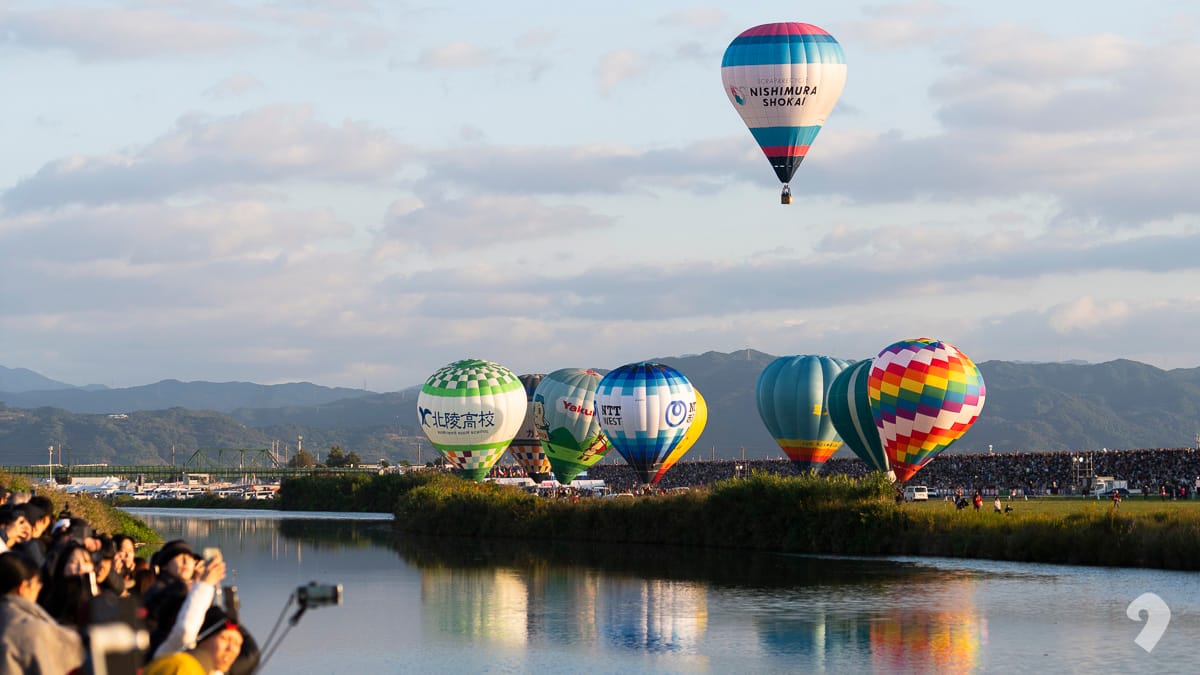
Those famous shots of hot-air balloons reflected in the water are taken from the opposite bank. That's where I chose to shoot, too. Even if you catch the first train from Saga Station, you may find the west bank already packed—some photographers arrive the night before to claim a spot. Mirror-like reflections need virtually no wind and perfectly still water, so they're rare. From the west bank you're also looking toward the sunrise, which is ideal for glowing dawn skies and dramatic backlit silhouettes. You'll need to cross a bridge to get here from the temporary station, so build in extra walking time and check the official festival map for the route.
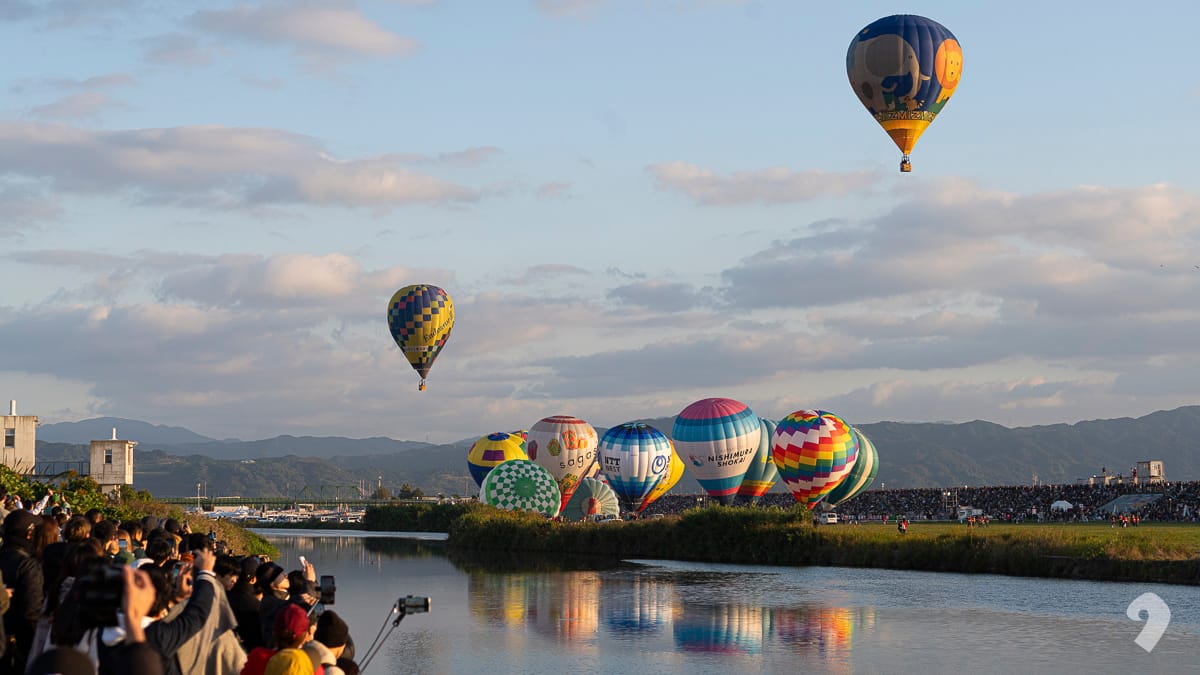
3. The riverbank near Kase Bridge (嘉瀬橋)
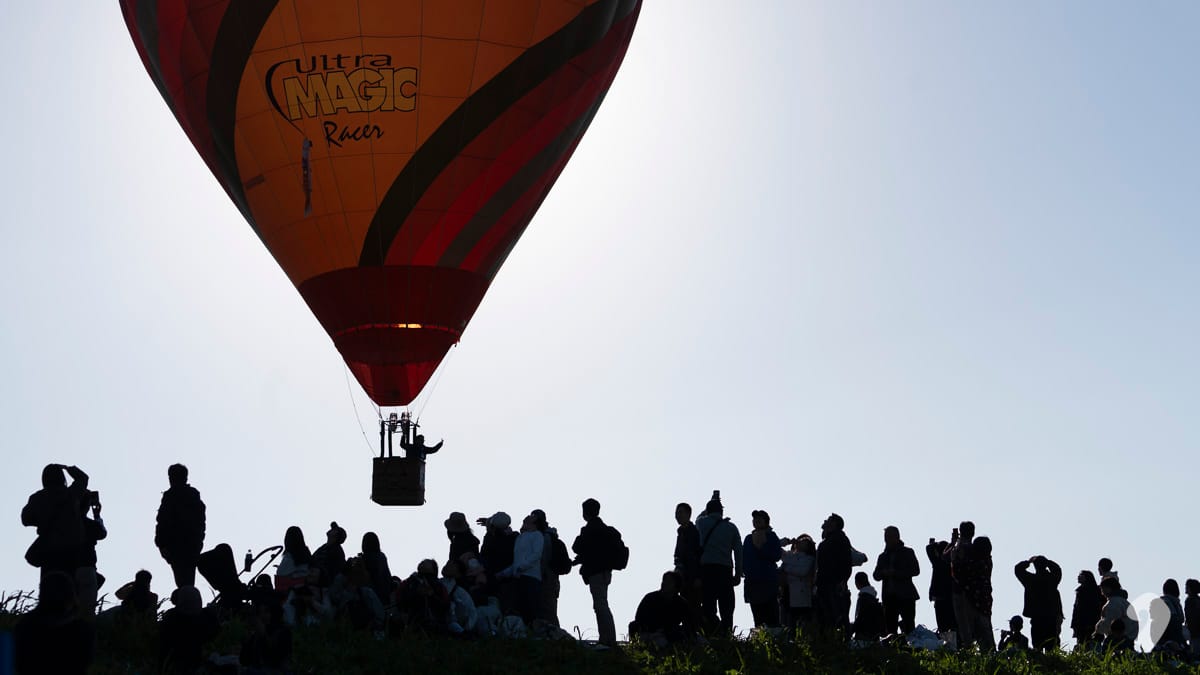
This open stretch offers sweeping views of the dawn sky before launch, people silhouetted along the embankment, and balloons drifting toward the city. You must not stop on Kase Bridge itself, so take your photos from the nearby riverbank instead.
- If the competition uses a fly-in format, balloons approach from outside the festival grounds and can pass surprisingly close overhead. Point a wide-angle lens upward for a truly dramatic shot.
- The railway bridge on the JR Nagasaki Main Line is right beside the grounds. Get your timing right and you can photograph a train and hot-air balloons in the same frame.
Can you get close to the balloons—or ride in one?
You can definitely get up close. On calm mornings, organizers may open the normally restricted launch area, allowing visitors to stand beside the giant novelty-shaped balloons for photos and even touch the balloon fabric. These three experiences don't require advance reservations, but all depend on the wind:
| Up-close experience | Dates and times | What you can do | Conditions |
|---|---|---|---|
| Balloon Fantasia (バルーンファンタジア) | October 30–November 3, after the morning competition until around 10:30 a.m. | If conditions allow, enter the normally restricted launch area, pose beside special-shaped balloons, and chat with pilots and crews | Only opens if wind conditions and the competition schedule allow; access is not guaranteed |
| Balloon School (気球教室) | Daily, 1–2 p.m. (scheduled) | Touch the balloon envelope, help pilots and crew inflate and raise it using fans and burners, then help pack it away | No reservation needed; bad weather may cause a schedule change or cancellation; no flights or tethered rides |
| Yakult Kids' Day (ヤクルト キッズデー) | Monday, November 2 | Children can enter the launch area and may get to step inside a balloon envelope | No reservation needed for families; in strong winds, activities may move outside the envelope or be canceled |
For photography, Balloon Fantasia is the clear winner. Twenty animal- and cartoon-shaped special balloons are registered this year. They stay upright on the ground rather than flying away, so you can stand beside one for a brilliant sense of scale. The organizers warn that wind often picks up as temperatures rise; the balloons may be packed away before the scheduled finish and generally won't be inflated again in the afternoon. The earlier you go, the better.
For Balloon School, wear comfortable clothes you don't mind getting dirty. The balloon fabric can be dusty, and you'll be lending a hand to get it upright.
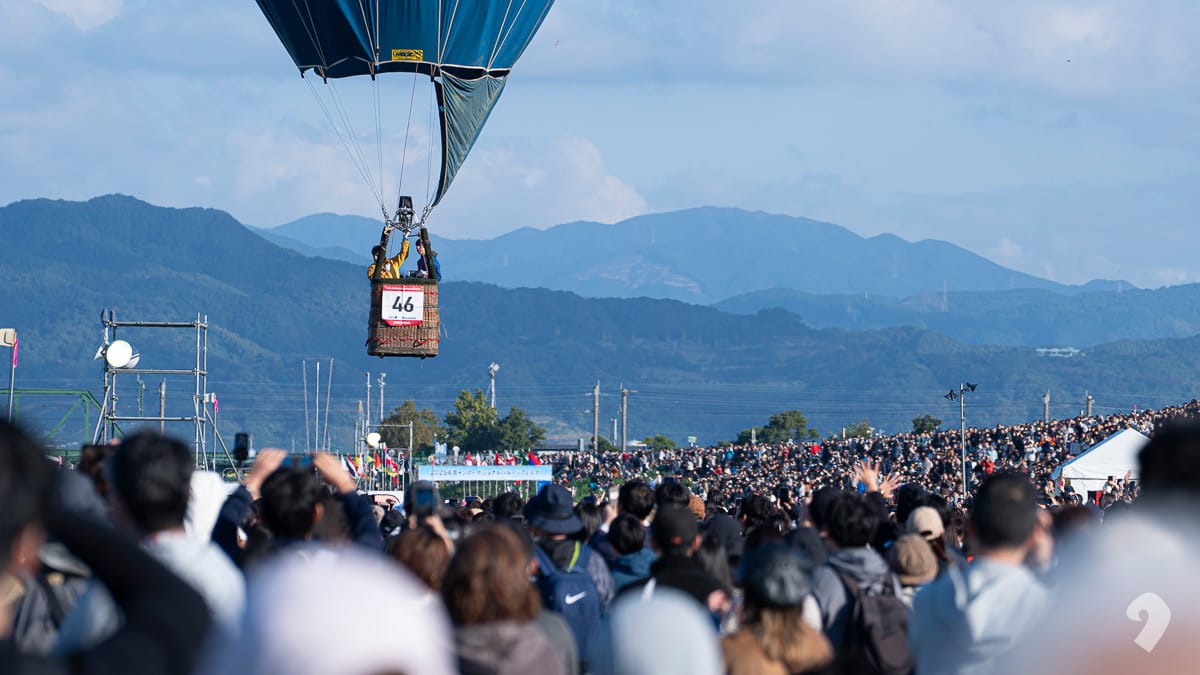
As for riding in a balloon, there are no public rides during the fiesta. The organizers stopped offering visitor flights in 2008, including tethered rides, with exceptions only for media coverage and sponsor hospitality. They explain that rides were once offered on the day when winds permitted, but unpredictable conditions and much bigger queues than expected caused crowd-control problems. They were discontinued for safety reasons.
If a balloon ride is on your wish list, come back after the festival. On Sunday mornings from late November to mid-February, the same Kase River floodplain hosts the SAGA Balloon Challenge Series (SAGA バルーンチャレンジシリーズ), featuring around 20 balloons and first-come, first-served registration on the day for tethered rides.
Which day should you visit?
My pick is Monday, November 2. As a weekday, it should be less crowded than the weekend or public holiday, yet it has everything: morning flights, Balloon Fantasia, Kids' Day, afternoon flights, and the nighttime illumination. You can photograph the balloons from dawn to after dark in a single visit. A TABIPPO photographer also recommends going on a weekday.
| Date | Daytime program | Evening | Why go? |
|---|---|---|---|
| Friday, October 30 | Competition flights at 7 a.m. and 3 p.m.; Balloon Fantasia | None | Weekday; generally quieter |
| Saturday, October 31 | Same as above | None | Weekend; among the busiest days |
| Sunday, November 1 | Same as above | None | Weekend; among the busiest days |
| Monday, November 2 | Same as above, plus Kids' Day | 6:30 p.m. balloon illumination | Weekday; fullest program |
| Tuesday, November 3 (public holiday) | 7 a.m. competition flights; Balloon Fantasia; 3 p.m. Key Grab Race | 6:30 p.m. balloon illumination | Public holiday; final day |
If your itinerary allows it, give yourself two mornings. That way, if flights are canceled because of wind one day, you'll have a second chance.
What happens at the nighttime balloon illumination—and how do you photograph it?
The nighttime illumination, La Montgolfier Nocturne (ラ・モンゴルフィエ・ノクチューン), is the fiesta's only evening event. In 2026 it starts at 6:30 p.m. on November 2 and 3 only. The balloons stay on the ground while their burners fire in time with music, lighting up the envelopes one after another.
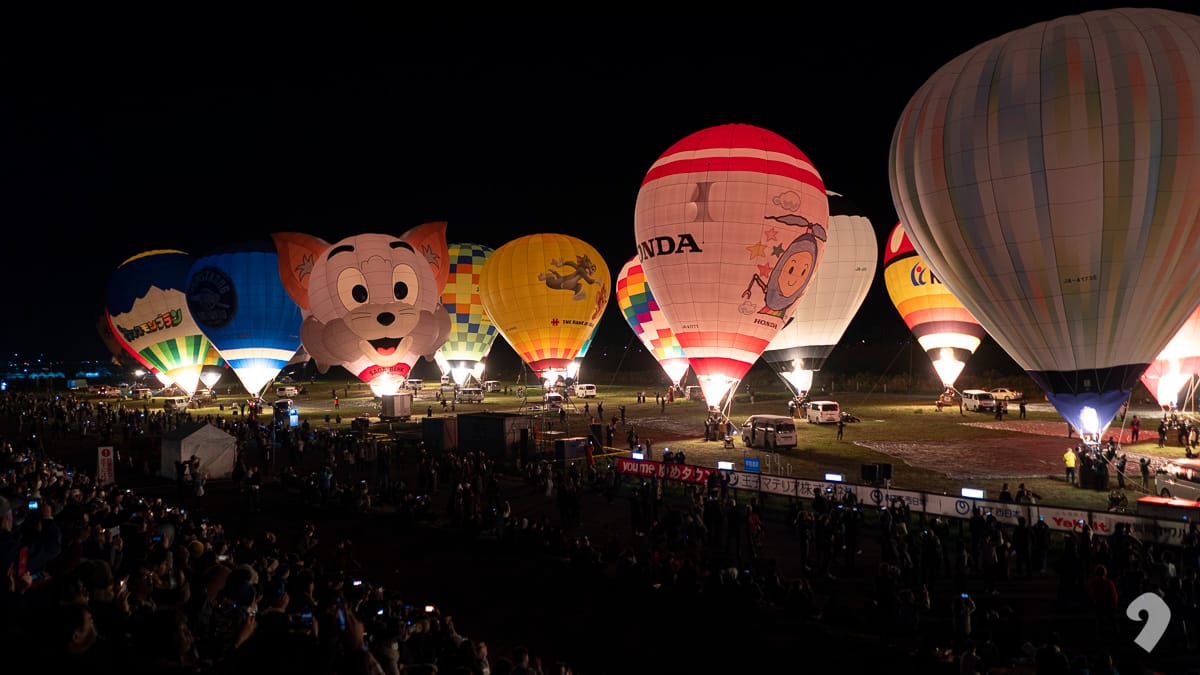
A few things to know before you head out with your camera:
- Sunset is around 5:26 p.m., so by 6:30 p.m. it's completely dark. The festival grounds' lights are also switched off during the show. Watch your step and bring a small flashlight or torch.
- Spectators can't enter the launch area during the show; photos must be taken from outside its perimeter.
- It gets crowded. A photographer from NICO STOP says it's difficult to walk around and shoot at the same time, so choose your position early. Their account of the 2019 show puts it at 6:30–7:15 p.m., ending with fireworks. The official website has not yet confirmed this year's finish time or whether there will be fireworks.
- Rain or strong winds may cancel the event, or force a modified version with burner flames but no inflated balloons.
- There are no lost-child announcements during the performance, so keep a close eye on children.
It gets noticeably chilly by the river after sunset, and the organizers specifically recommend bringing warm layers for the nighttime show.
What are the balloons competing for—and why are flights sometimes canceled?
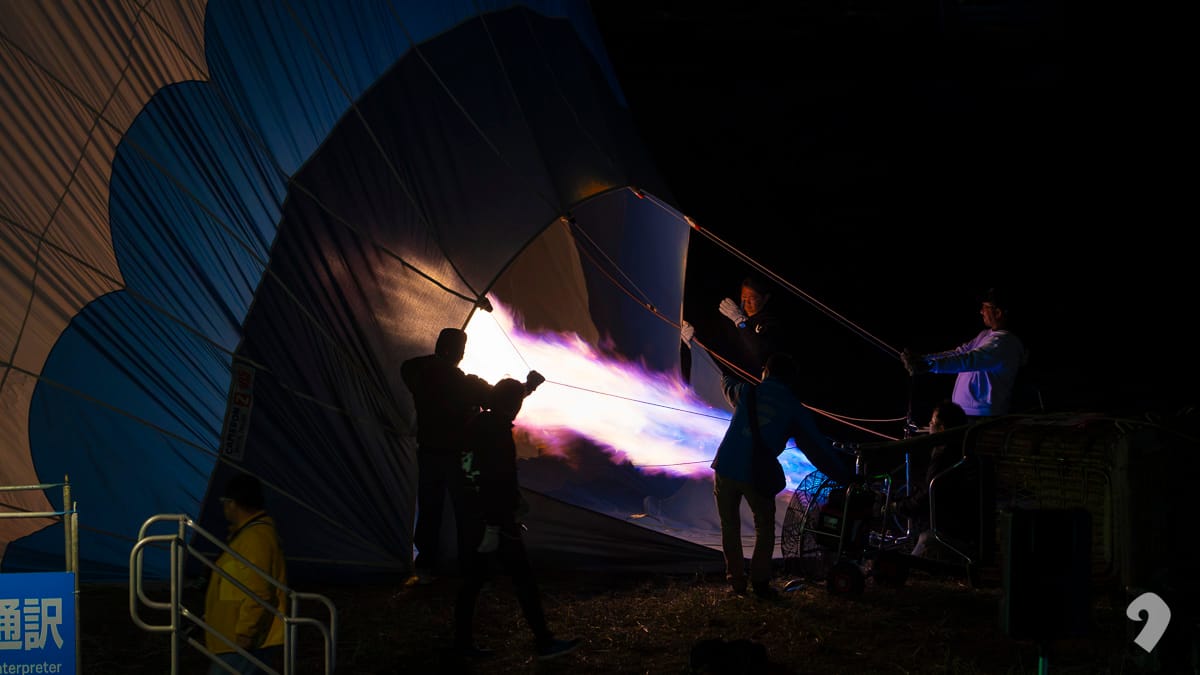
This is a real sporting competition. The aim is to fly as close as possible to a target and drop a marker onto a designated spot on the ground. Pilots can control how high or low their balloons fly, but not their horizontal direction. To steer, they read the winds at different altitudes and rise or descend to catch the right current.
For photographers, there are just two key things to remember:
- Competition flights are scheduled twice daily, from 7–9 a.m. and 3–5 p.m. On the final day, only the morning session is a regular competition flight.
- Balloons won't fly in rain, poor visibility, or strong winds—even when the sky is sunny. Whether flights go ahead, and whether the format is a mass launch or fly-in, is decided at pre-session briefings around 6 a.m. and 2:30 p.m. Announcements follow over the festival PA system, on the official website, and on the organizers' X account, @SIBFO.
How do you get there from Fukuoka?
The easiest option is to take a JR train to Balloon Saga Station (バルーンさが駅), a temporary stop right inside the festival grounds that operates only during the five-day event. If you're flying into Fukuoka Airport, the subway takes about five minutes to reach Hakata Station, where you can connect to JR services.
| Departure station | Train | Journey time | One-way fare |
|---|---|---|---|
| Hakata Station | Special limited express Kasasagi No. 91 (departs 5:03 a.m., arrives 5:47 a.m.) | About 44 minutes | Online discount fare: ¥1,540 (reserved seat) |
| Hakata Station | Special limited express Kasasagi No. 93 (departs 5:35 a.m., arrives 6:22 a.m.) | About 47 minutes | Same as above |
| Hakata Station | Special limited express Kasasagi No. 95 (departs 6:10 a.m., arrives 6:57 a.m.) | About 47 minutes | Same as above |
| Saga Station | JR local train | About 4–5 minutes | ¥240 |
If you want to claim a spot on the west bank before sunrise, the 5:03 a.m. departure from Hakata gives you more breathing room. Better still, spend the night near Saga Station. The organizers warn that conveniently located hotels book up quickly.
Two discounted rail tickets are on sale from September 30 to November 3, 2026:
- バルーンさがネットきっぷ (Balloon Saga Online Ticket): One-way from Hakata to Balloon Saga Station, ¥1,540 for adults and ¥770 for children. Available only through the JR Kyushu online train reservation service (JR 九州インターネット列車予約); QR Ticketless entry is supported.
- バルーンさが日帰り往復きっぷ (Balloon Saga Day-Trip Return Ticket): Same-day return ticket, ¥3,380 for adults and ¥1,690 for children. Valid in unreserved seats only and sold at reserved-seat ticket machines at Hakata, Sasabaru, Minami-Fukuoka, and Kasuga stations.
Neither ticket is valid on the Kyushu Shinkansen. You can't collect online-purchased tickets at Balloon Saga Station, so consider QR Ticketless or a transit IC card for your return journey. The full train timetable is expected to be updated in late October; double-check it before you travel.
Practical information
Festival essentials
| Item | Details |
|---|---|
| Event | 2026 Saga International Balloon Fiesta (2026 佐賀インターナショナルバルーンフェスタ) |
| Dates | Friday, October 30–Tuesday, November 3, 2026 (public holiday on November 3) |
| Location | Kase River floodplain (嘉瀬川河川敷), Saga City, Saga Prefecture |
| Admission | Free |
| Number of balloons | 123 (98 from Japan and 25 from overseas) |
| Nearest station | JR Balloon Saga Station (バルーンさが駅), open only during the five festival days |
| Parking | North festival parking lot: ¥2,000 per vehicle per entry. Parking fills up on weekends and public holidays; organizers recommend taking JR trains. |
| Contact | Saga Balloon Fiesta Organizing Committee: 0952-29-9000 |
| Official website | https://www.sibf.jp/ |
Photography rules
- No drones: Drones and multirotor aircraft are strictly prohibited throughout the event.
- Tripods: Permitted, provided they don't block pathways.
- Long lenses: The organizers warn that cameras and lenses often bump into people, especially children, so take care when turning around.
- Embankment steps: Don't sit on the steps; they're the only access route up and down the riverbank.
- Launch area: Entry is prohibited without permission. Only enter when instructed during events such as Balloon Fantasia.
- Social media posts: Personal, noncommercial sharing is unrestricted. The organizers welcome posts tagged #佐賀バルーンフェスタ.
What should you pack?
- Warm jacket: Temperatures can swing dramatically. Organizers say you might need a winter jacket in the morning, short sleeves in the afternoon, and another layer by evening.
- Hat, sunglasses, and face mask: Midday sun can be strong, and crowds can kick up dust from the riverbed when the weather is dry.
- Picnic blanket or folding chair: Handy while waiting on the riverbank.
- Comfortable walking shoes: Expect gravel paths and steps along the embankment.
- Spare battery or power bank: A full day of shooting from dawn into the evening can drain your devices.
Rainy-day backup plan
| Item | Details |
|---|---|
| Name | Saga Balloon Museum (佐賀バルーンミュージアム) |
| Address | 2-2-27 Matsubara, Saga City |
| Opening hours | 10 a.m.–5 p.m. (last admission 4:30 p.m.) |
| Closed | Mondays (or the following day if Monday is a public holiday), and December 31–January 1. The festival website says the museum stays open during the fiesta, but because November 2 falls on a Monday, check before visiting. |
| Admission | Adults ¥500; elementary, junior high, and high school students ¥200; preschool children free |
| Official website | https://www.sagabai.com/balloon-museum/ |
During the festival, the Machinaka Shuttle Bus (街なかシャトルバス) runs between the grounds and downtown Saga from 9 a.m. to 5:10 p.m. Fares are ¥250 for adults and ¥130 for elementary school children.
Frequently asked questions
When is the best time to take photos?
Early morning. Sunrise is around 6:35–6:38 a.m., and the balloons launch at 7 a.m., when the light is soft and winds are usually calmest. For reflections on the water, be on the opposite riverbank before sunrise.
Can you get close enough to photograph the balloons?
Yes, weather permitting. After the morning competition, Balloon Fantasia may open the launch area so visitors can stand beside the special-shaped balloons. At the daily 1 p.m. Balloon School, you can even touch the balloon fabric.
Which evenings feature the balloon illumination?
Monday, November 2, and Tuesday, November 3 (a public holiday), 2026, from 6:30 p.m. Rain or strong winds may cancel it or lead to a burner-only display without inflated balloons.
Can you ride in a hot-air balloon at the Saga festival?
No public rides have been offered at the fiesta since 2008, including tethered experiences. For a chance to ride, look into the SAGA Balloon Challenge Series, held on Sunday mornings at the same site from late November to mid-February.
Can you take drone photos?
No. Small unmanned aircraft, including drones, are prohibited throughout the festival because they could collide with airborne balloons or fall and injure spectators.
That incredible photo of colorful balloons filling the sky over Saga isn't just a social-media fantasy. You can stand on the riverbank and watch more than 100 balloons rise, get right beside them on a calm morning, and enjoy it all for free. Choose a weekday, book a night near Saga Station, and arrive before sunrise for your best chance of coming home with unforgettable photos. Schedules and train services may still change in late October, so check the official website again before setting off.